
If you’re in the content or niche site game, chances are the past year has been brutal for you.
I have my agency as my main source of income. But still… Google’s HCU, this year’s March Core Update…
And, as I’ve shared previously, I’ve turned things around for one of my sites. But this is a story about letting go.👇
I’m going to share my story about a different site. Hopefully it helps you decide whether it’s time to fight for your site or let go and move on to bigger opportunities.
I’ll even get philosophical and talk all about a logical fallacy that plagues me daily.
Quick Navigation
Pivoting to Pinterest: A Redemption Arc
One of these sites, which I’ve talked about before, was a perfect candidate for pivoting. It was in the food niche, and I knew that if I could get it ranking on Pinterest, I might just have a shot at getting some traffic back and—most importantly—revenue flowing again.
Fast forward to this spring, when I decided to make Pinterest a key focus for that struggling site. With consistency and a refined strategy, here’s what happened:
- April: $137.54
- May: $198.74
- June: $352.01
- July: $311.63
- August: $558.34
- September: $1,938.55 (!!)
Yes, you read that right—from just a couple hundred bucks to nearly $2,000 a month! All from focusing on Pinterest traffic. This was a site Google has forgotten about, but Pinterest brought it back to life.
Here’s exactly how I made it work.
It’s encouraging, because it proves that there are other ways to drive traffic, even when Google lets you down. And while this story might seem like a big win—and trust me, it is—there’s a lot more to it than just throwing pins up and hoping for the best.
With Pinterest, it’s basically find the trending topics in Pinterest. Create engaging pins. Rinse and repeat. We’re following the process Tony Hill teaches (you can watch his FREE mini-course to learn more).
Not quite that simple… but you get the point.
Now, this strategy has worked wonders for this particular site, but it’s not a silver bullet for all niches.
The Other Side of the Coin: Knowing When to Walk Away
Not every site can be saved. Take my finance niche site as an example—so far, it’s had an entirely different outcome.
I bought this aged domain a few years ago from a colleague. It did have some content on it, but not much. It was already aged, with a DR of 21, and I got it for $2,000, thinking it had great potential.
Look at some of those high powered, finance specific backlinks!
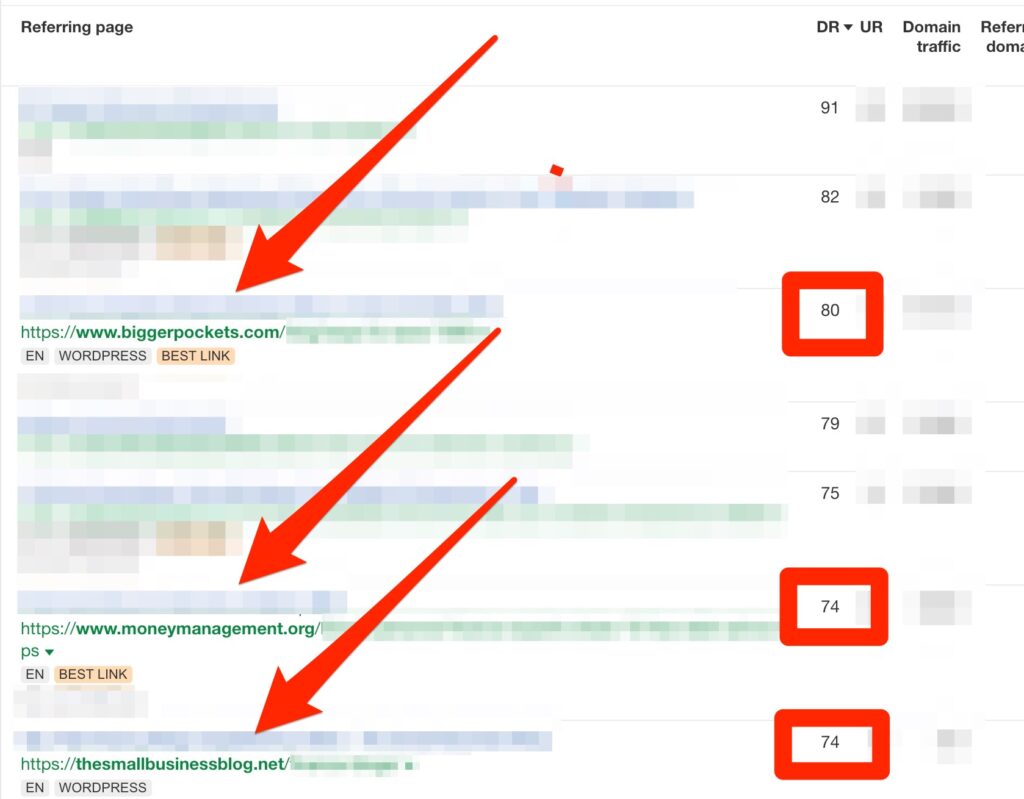
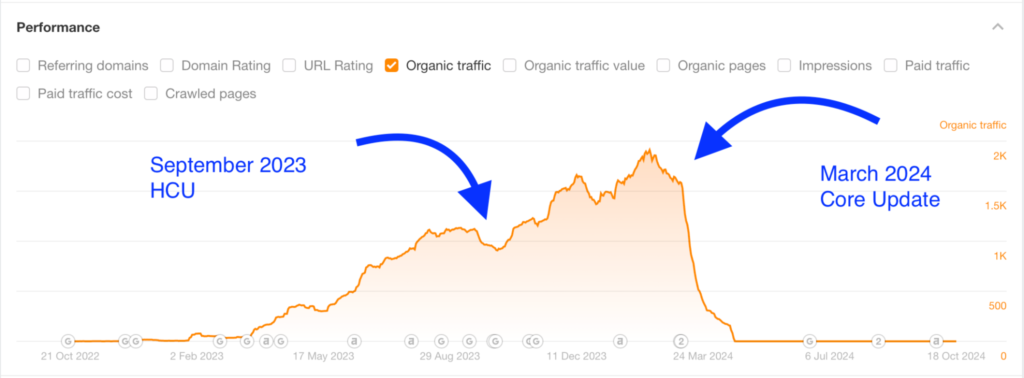
We built up the content, targeting finance-related keywords that I knew could pay off big in the long run. Things were starting to look good… and then it survived the HCU!
Oh. But then there was the March 2024 Core Update. Overnight, traffic and revenue dropped off a cliff.
I started considering other platforms where finance content could thrive—like LinkedIn, Twitter, email newsletters, even a podcast or YouTube.
But after a lot of soul-searching, I realized something important: it just wasn’t worth the time anymore.
Now, let’s talk about why this decision was so tough—and why it’s a decision you may need to make at some point, too.
Fighting the Sunk Cost Fallacy
The sunk cost fallacy is the idea that we tend to stick with things simply because we’ve already invested so much time, money, or energy into them. It’s that nagging voice in your head that says, “But I’ve already put $2,000 into this site. I have to make it work!”
Here’s the truth: just because you’ve invested heavily in something doesn’t mean you should keep going. When a project is no longer viable, it’s okay to walk away.
That’s exactly what I did with this finance site. After running the numbers and considering the opportunity cost (another important concept), I decided it was time to cut my losses.
But I didn’t completely walk away empty-handed.
I sold the domain to ODYS for $1,000—recouping half of my original investment.
Definitely not a “win”… but maybe it is? Once I acknowledge that the odds are VERY low that I would ever take this project back on? At least not in its current form.

I’ve got so many other side hustles. My Pinterest site that I shared above. Amazon Influencer. Medium. Heck, this newsletter.
And here’s the kicker on this deal: I still own all the content.
So while the site didn’t pan out, I can repurpose that content elsewhere or hold onto it for future projects. And I might. I like the finance niche.
This decision freed up time to focus on things with real potential, like my now-thriving Pinterest strategy.
The Takeaway: Be Honest About Your Time and Your ROI
This brings me to an important point: you’ve got to be honest with yourself about how much time you’re willing to invest in a project, and whether the potential return on investment (ROI) makes it worth that time.
It’s not easy, and it’s a HUGE struggle of mine.
I constantly think I have more time than I do, and the sunk cost fallacy plays with me at all times.
In some cases, like my food niche site, investing the time to pivot paid off. In others, like my finance site, it didn’t. The important thing is to make those tough decisions and move on when the time is right, rather than getting trapped by sunk costs or unrealistic expectations.
Final Thoughts: Your Next Move
So, what’s your next move? Are you going to double down on a project that still has potential, or is it time to let go and move on to something more promising? Take a hard look at your portfolio and your time, and make the decision that serves you best.
And going forward, it’s back to focusing on what IS working. For my other site, it’s Pinterest. If you’re curious about how Pinterest could fit into your strategy, Tony Hill put together this free mini-course that you should check out! We are following his methods for our success story!